



URWERK has never been interested in making ordinary watches. The Geneva-based independent has spent nearly three decades building machines that look more at home on the bridge of a starship than in a traditional watch box. Now the company is giving one of its most recognizable creations a final sendoff with the UR-120 Blue Planet, a limited edition of 20 pieces that closes the book on the UR-120 series.
The Blue Planet is the third and final version of the UR-120, a watch that became famous not only for its wandering satellite display but for a clever complication that causes its hour indicators to split apart and form a Vulcan salute. It is a fitting farewell for a watch that has always worn its science fiction influences proudly.
The new model is dominated by a deep blue colorway that gives the watch a different personality from previous versions. The sandblasted titanium and steel case measures 47mm wide, 44mm long, and 15.8mm thick. While those dimensions sound imposing, URWERK’s articulated lug system helps the watch sit comfortably on the wrist. A hidden spring integrated into the lower lug further improves wearability.
One of the most interesting aspects of the case is its construction. The watch is built around a two-part design consisting of a base and an upper shell that fit together seamlessly. The result is a smooth, uninterrupted surface that hides the complexity beneath. Viewed from above, the Blue Planet resembles a small spaceship more than a conventional wristwatch.
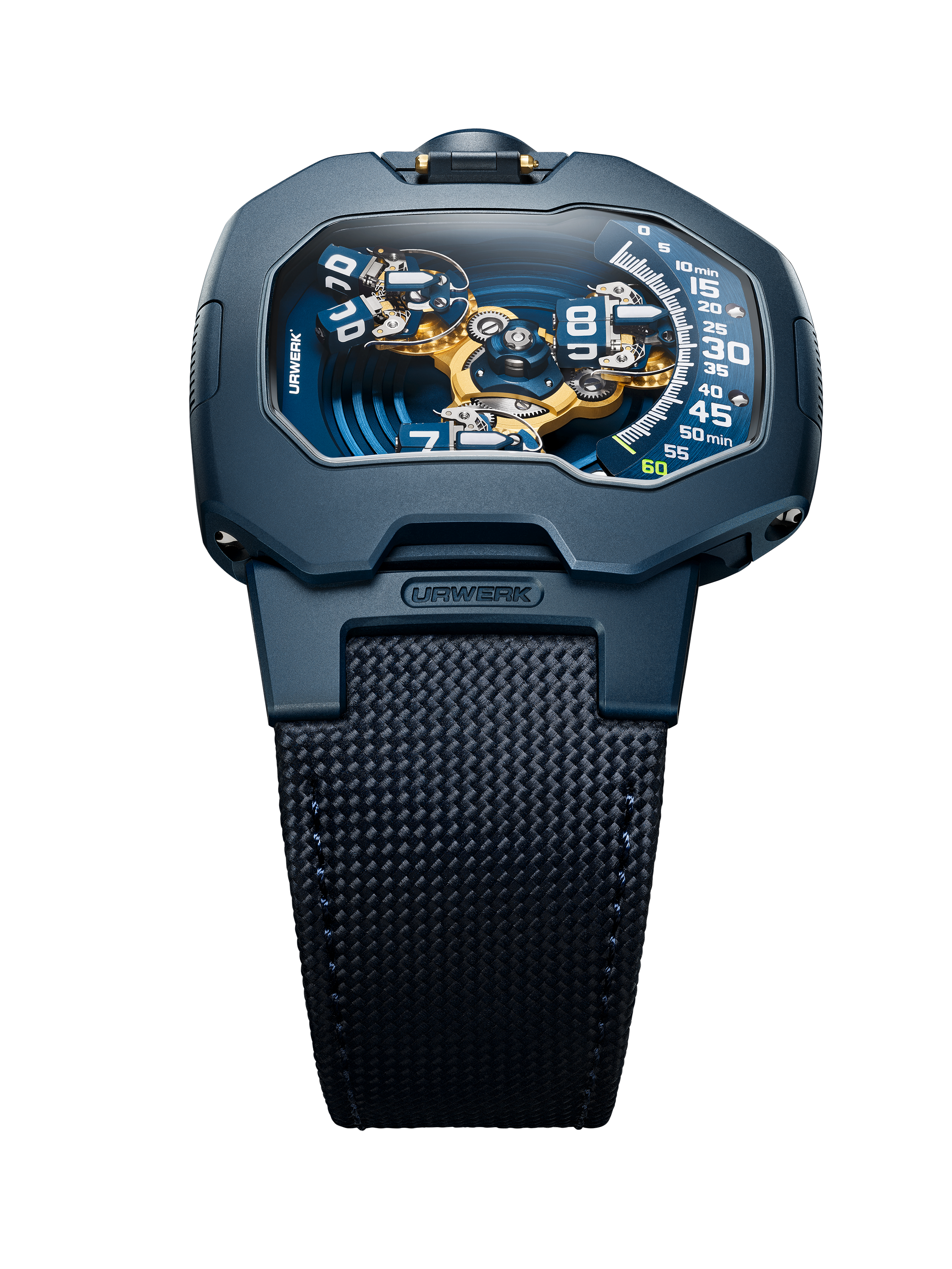
Inside is the self-winding Calibre UR-20.01, a movement that does far more than simply tell time. Three hour satellites orbit around a central carousel, each taking its turn moving across the minute track. As a satellite reaches the left side of the display, its two rectangular arms separate into a V shape before disappearing beneath the dial and resetting for another cycle.
According to URWERK, the carousel alone contains 175 components. The opening and closing of the satellite arms is controlled by a lyre-shaped spring, while Maltese cross mechanisms coordinate the movement of the display. The result is one of the most distinctive time displays in modern watchmaking.
URWERK has highlighted these components by coating the lyre springs and Maltese crosses in 24-karat yellow-gold PVD. Against the blue architecture of the watch, the gold elements stand out dramatically, drawing attention to the parts of the movement where energy is stored and released. Rather than serving as decoration, the gold helps explain how the mechanism works.
The movement beats at 4 Hz and offers a 48-hour power reserve. It uses a mix of materials including titanium, anodized aluminum, ARCAP, brass, beryllium copper, and LIGA-produced components finished with atomic layer deposition treatments. As with most URWERK watches, the technical specifications read more like those of an aerospace project than a traditional luxury watch.
The UR-120 Blue Planet is fitted with a blue Cordura-textured calfskin strap and is water resistant to 30 meters. Production will be limited to just 20 pieces worldwide.
Priced at CHF 115,000 before taxes, the Blue Planet occupies a rare corner of horology where mechanical engineering, industrial design, and science fiction storytelling meet. More importantly, it marks the end of one of URWERK’s most imaginative platforms. For collectors who appreciate independent watchmaking at its most unconventional, this final transmission from the UR-120 may be the most memorable one yet.


