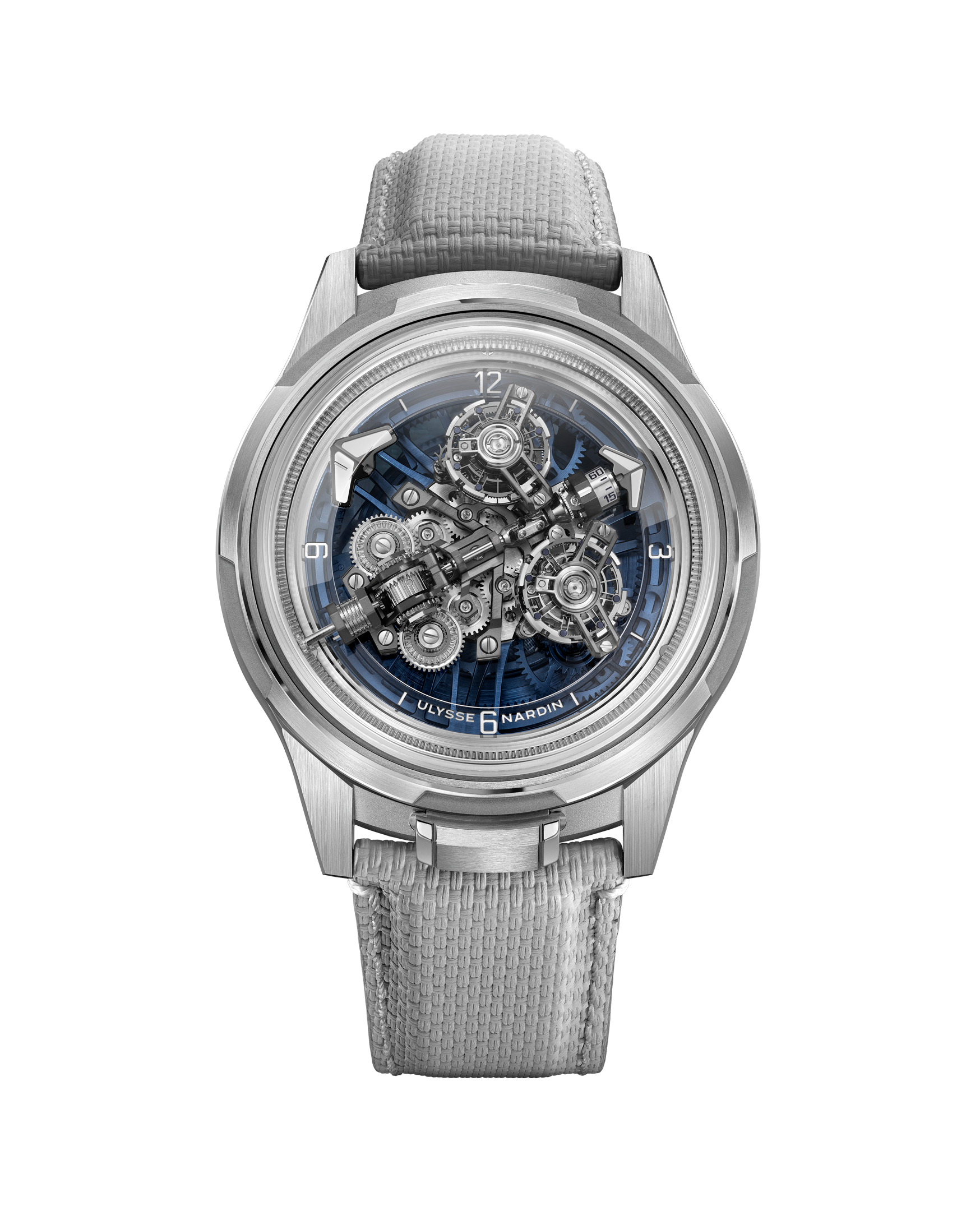
Ulysse Nardin announces the [Super]Freak (It's [Super]Freaky)
Ulysse Nardin is marking 25 years of the Freak with what it calls the [Super] Freak, a watch that pushes the concept to its limit. The brand frames it as the most complicated time-only watch ever made, which sounds like marketing language until you look at what is actually inside. This is still a watch that shows hours, minutes, and now seconds, but it does so through a system that is closer to a moving machine than a traditional dial.
The core idea of the Freak remains intact. There is no conventional dial, no standard hands, and no crown. Time is displayed through the movement itself. The entire mechanism rotates, with the movement acting as the minute hand and a rotating hour disc completing the display. On the [Super] Freak, that system has been expanded to include a seconds display, which required a new gimbal system to manage energy transmission across moving axes.


What sets this version apart is the addition of a double tourbillon. Two inclined flying tourbillons, each set at 10 degrees and rotating once per minute, sit on a lightweight titanium structure made up of hundreds of components. They are connected through what Ulysse Nardin describes as the world’s smallest differential, a 5 mm mechanism that averages their rates to maintain stability. The entire caliber, UN-252, consists of 511 components, with more than 97 percent of them in motion at any given time.
Powering all of this requires a different approach. The watch uses the brand’s Grinder system, an automatic winding setup designed to capture even small wrist movements and convert them into usable energy. Despite the complexity, the system delivers a power reserve of around three days. The use of silicon and DIAMonSIL components throughout the escapement helps reduce friction and increase durability, a continuation of Ulysse Nardin’s long focus on non-traditional materials.
The case measures 44 mm in white gold, with a sapphire front and back to expose the movement. The design is dense but legible once you understand how to read it. The hour disc is made from a translucent material called Nanosital, giving a blue-tinted view into the mechanism beneath. The watch is set via the bezel and wound through the caseback, consistent with earlier Freak models.
Production is limited to 50 pieces, each assembled by a single watchmaker over roughly 60 hours, followed by several days of testing. Pricing is set in the range of high complication territory, just under 400,000 USD depending on market.
The Freak has always been a concept watch that made it into production. The [Super] Freak continues that idea but takes it further into the realm of engineering exercise. It is not about practicality. It is about showing how far a mechanical watch can be pushed while still technically telling the time.