In review: The Vario 1918 Trench
A beautiful retelling of the classing tool watch.
Trench watches were the first wristwatches. Designed for Doughboys in World War I, they were essentially pocket watches retrofitted, usually with welded lugs, into wristwatches. This meant they were often big and thick and featured a unique cage system that protected the crystal from bumps and scrapes.
They were also the first watches with real radioactive lume, which ties them directly to one of the darkest chapters in industrial history. The radium used to make those dials glow was applied by hand, almost always by young women — the so-called Radium Girls — hired to paint the numerals and markers. They were told the material was safe. They were even encouraged to lick their brushes to keep a fine point. Over time, the radium accumulated in their bodies, attacking their bones and organs. Many became seriously ill or died before anyone admitted what was happening. Their lawsuits changed labor law and workplace safety in the United States, but the cost was enormous.
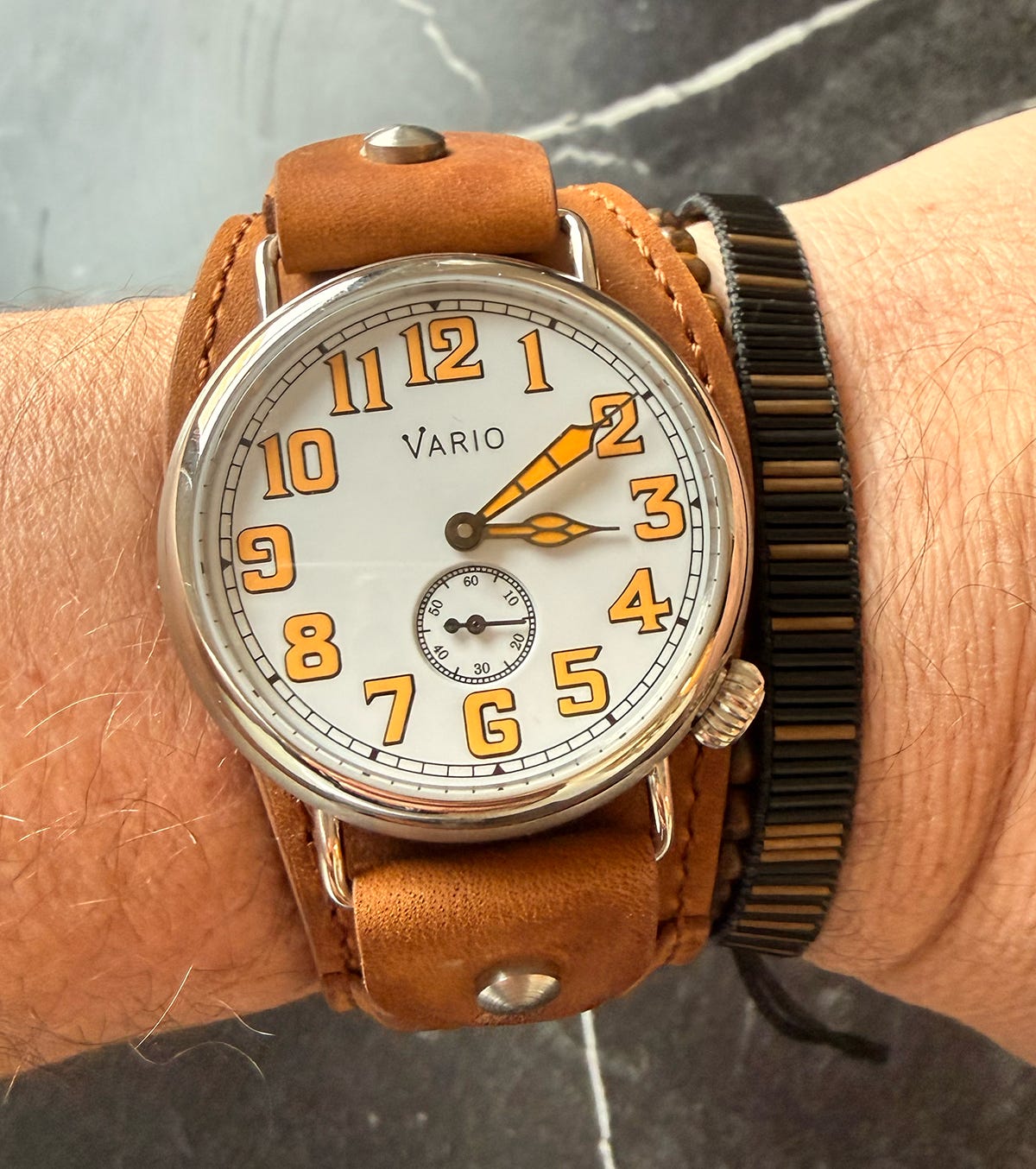
Vario, a fascinating watchmaker based in Singapore, is bringing these stylish and bold watches back with their 1918 Trench series, and I was lucky enough to get to try on a white and orange model that looks like it would be right at home in a muddy trench or on a steam train home after the war.
At first glance, this watch leans hard into history without feeling dated. It’s a modern take on the World War I trench watch style, with a clean white dial and bright orange lume for visibility in low light.
The dial is a robust modern enamel rather than a fragile old-school finish, and the crystal is anti-reflective sapphire, so you do not fight glare just to read the time. The case is marine-grade stainless steel with full wire lugs — not spring bars — giving it a solid feel that can take daily knocks without feeling precious. It also offers 100 meters of water resistance and a hacking Miyota 82S5 automatic Japanese movement, a little extra that makes this thing truly stand out.
The back is etched with a soldier in a field of poppies and is etched with 11.11.1918 — Armistice Day.
Out of the box, it comes on a bold leather Bund strap with screwed-down flaps. You can also grab a matching NATO strap, although I highly recommend the Bund.
The watch comes in other permutations, including a nice black on white, red, and green. The Medic line has a full pulsometer on the face, a style of tachymeter with graduée pour 30 pulsations along the top and a readout along the bottom to measure heartbeats per minute.
Wearing it feels compact and purposeful rather than bulky. The roughly 37 mm case size and classic proportions make it friendly on a range of wrists. I personally love the finishing, especially the way light plays off the enamel dial and the lume actually stands out in dim conditions. It’s a true trench watch with a lot of history and a lot of quality built in.
At $388, the watch is more than affordable. I really like Vario’s choices here, and they’ve done a great job capturing the heart of the trench without making it fussy or small. They also make Art Deco GMTs and even quartz chronographs, but these 1918s are probably the best of the bunch.
You’ve probably seen these things on Instagram, and if you’re anything like me, you’ve been intrigued. I can honestly say they are probably the nicest classic pieces you’ll find at this price point and well worth checking out.
The 1918 Trench is a thoughtful blend of old and new, a watch that stands on its own as an everyday piece while nodding to the story of early wristwatches. If you like watches with history and substance but also want features you can live with right now, this is worth a $400 investment.


I have a JW Benson trench watch that I love. Trench watch dials are magnificent.